

Hybrid events, combining physical venues with virtual platforms, often cost 1.5 times more than in-person events due to their dual demands. A 2019 $50,000 event could now range from $75,000 to $120,000. Here’s why:
- Technology and Platforms: 30%-60% of the budget, with virtual platforms costing $2,000-$100,000 and AV setups ranging from $2,000 to $10,000/day.
- Venue: 20%-30% of the budget, influenced by space for equipment and social distancing. Costs can hit $15,000+ for mid-sized events.
- Staffing: Dual teams for in-person and virtual components, with specialized roles like technicians and producers costing $8,000-$10,000/day.
- Speakers and Emcees: Fees vary widely, from $500 for local talent to $50,000+ for celebrities. Hybrid setups often need separate emcees for each audience.
- Audio-Visual Production: Dual setups for live and virtual audiences drive costs up, with small events averaging $50,000 and larger ones starting at $150,000.
- Catering: In-person attendees require traditional meals, while virtual participants might receive snack boxes ($5.60+) or meal kits ($63).
- Marketing and Contingency: 10%-15% of the budget covers promotions, branding, and unforeseen expenses like technical glitches or safety measures.
Hybrid events require careful planning to balance costs while ensuring both audiences feel equally engaged. Budgeting for technology, staffing, and dual setups is key to success.

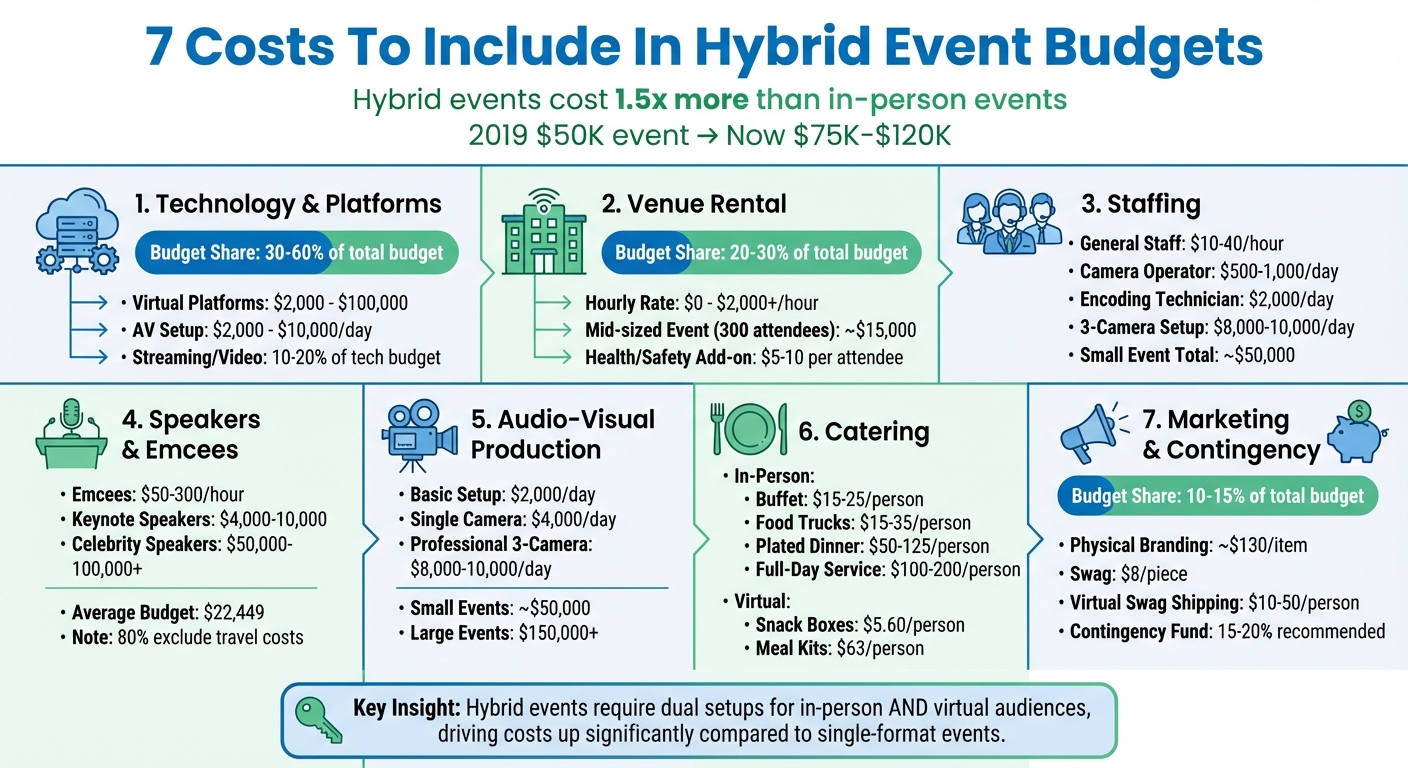
7 Essential Hybrid Event Budget Categories with Cost Breakdown
Interview with Event Producer on Hybrid Events [Event Insider 7]

sbb-itb-1e56dfa
1. Technology and Event Platform
The success of a hybrid event hinges on reliable technology that seamlessly connects in-person and virtual experiences.
Cost Range and Estimates
Technology expenses typically make up 30% to 60% of your total hybrid event budget. A significant portion of this goes to the virtual event platform – the digital hub where virtual attendees register, watch sessions, and interact. These platforms can consume 20% to 35% of your tech budget, with costs ranging from $2,000 for basic setups to over $100,000 for enterprise-level solutions.
Audio-visual (AV) production is another major cost factor. For example:
- An encoding technician costs about $2,000 per day.
- A single-camera setup with an operator runs around $4,000 daily.
- A professional three-camera production can range between $8,000 and $10,000 per day.
Additionally, streaming and video production often account for 10% to 20% of your technology budget.
Key Considerations for Planning
Your event platform should go beyond basic streaming. Opt for solutions that integrate multiple features, such as registration, mobile app support, live polling, Q&A tools, and analytics – all in one system. This approach simplifies management and reduces the need for multiple software subscriptions.
"The foundation of any hybrid event is top-notch event technology that not only perfectly performs in both the live and virtual settings, but also connects in-person and virtual audiences as if they were together in the same venue." – AV Alliance
Standard venue Wi-Fi isn’t enough for hybrid events. Dedicated wired internet with a reliable backup is essential to avoid streaming failures. Keep in mind that this cost is often separate from the AV provider’s quote and must be negotiated directly with the venue.
Potential Cost-Saving Tips
- Use platforms with tiered pricing based on attendee numbers to avoid paying for unused capacity.
- Consolidate content into fewer rooms to reduce equipment and staffing needs.
- Consider browser-based tools like StreamYard or Restream for smaller budgets. These tools can handle speaker feeds and branded overlays at a fraction of the cost of professional production.
- Train your internal team to manage virtual chats and Q&A sessions instead of hiring external moderators.
- Allocate a 15% to 20% contingency fund for unexpected technical issues or last-minute upgrades.
- Repurpose event recordings for post-event marketing to maximize your investment.
Investing in the right technology lays the groundwork for managing other critical hybrid event costs effectively.
2. Venue Rental
After locking in reliable technology, choosing the right physical venue is a key element in making your hybrid event successful.
Cost Range and Estimates
Venue rental prices can range from $0 to over $2,000 per hour. For hybrid events, venue and infrastructure costs usually make up 20% to 30% of your total event budget. For example, a mid-sized event with about 300 attendees might allocate around $15,000 for venue-related expenses. On top of that, health and safety measures could add another $5 to $10 per attendee.
Relevance to Hybrid Events
The venue is more than just a physical space – it’s the stage for your live stream and directly affects the virtual audience’s experience. Even though hybrid events typically have smaller in-person audiences, you may still need a larger venue than expected. Why? Social distancing rules and space for equipment like risers, lighting rigs, and tech booths mean you’ll need more room per person compared to traditional setups.
Key Considerations for Planning
Traditional hotel venues often come with challenges like minimum spending requirements for food, beverages, and room blocks – costs that can be hard to justify with reduced in-person attendance. Many also insist on using their in-house AV services, which can be pricey. Before signing anything, make sure the venue offers dedicated, hardwired internet with guaranteed bandwidth. Also, carefully review cancellation policies and "force majeure" clauses, as these have become more intricate post-pandemic.
Potential Cost-Saving Tips
Looking for savings? Think outside the box. Independent venues like warehouses or studios often offer more flexible pricing and fewer restrictions on vendors, letting you handle catering and production on your own terms. Booking early can also help secure better rates. Another idea: repurpose breakout rooms as live-streaming studios to cut costs. If your in-person attendance drops from 300 to 100 guests, you could reduce venue costs to about one-third of what a fully in-person event would require.
Some modern venues, like Aloft Trophy Club Westlake, provide flexible meeting spaces equipped with advanced technology and high-speed WiFi. These venues are designed with hybrid events in mind and often avoid the rigid pricing models of traditional hotels.
Choosing the right venue is critical to balancing affordability with the technical needs of a hybrid event, ensuring both in-person and virtual attendees have a seamless experience.
3. Staffing
Cost Range and Estimates
Staffing is a major expense when it comes to hybrid events. General event staff typically charge between $10 and $40 per hour, but specialized roles can significantly increase costs. For instance, hiring a camera operator costs $500 to $1,000 per day, while an encoding technician can charge around $2,000 per day. If you’re planning a multi-camera setup with three cameras, operators, and an encoding technician, expect to spend $8,000 to $10,000 per day. Overall, producing a small hybrid event could run you about $50,000, compared to $25,000 to $35,000 for an in-person-only event.
Relevance to Hybrid Events
Staffing costs rise sharply for hybrid events because they require personnel for both in-person and virtual components. New roles, such as an executive producer to manage the broadcast and a virtual advocate to ensure online attendees remain engaged, are now essential.
"AV is double the price I was looking at before the pandemic. Cameras and operators for every room, more computers, a lot more on the platform side" – Lauren Kerr, Director of Events at Bizzabo
The increased complexity of hybrid events means staffing becomes a critical – yet costly – part of the planning process.
Key Considerations for Planning
Given these additional staffing needs, you should budget for 1.5 times your traditional event costs. Each session typically requires a dedicated camera operator, audio technician, and streaming engineer. Specialized roles like executive producers and virtual guides add another layer of expense.
For events with multiple sessions running simultaneously, your costs will grow with each additional room requiring its own technical team. Global events spanning different time zones can also lead to overtime pay. Other roles to consider include social media moderators (costing $10–$25 per hour), on-site video editors for instant content creation, and cybersecurity personnel to protect attendee data.
Potential Cost-Saving Tips
To keep staffing costs under control, here are a few strategies:
- Consolidate sessions into fewer rooms: This reduces the number of camera operators and technicians you need.
- Scale down physical staffing: If your in-person attendance drops (e.g., from 300 to 100 attendees), you can cut down on-site staff by about a third and reallocate funds to virtual production.
- Choose independent venues: Opt for venues that allow you to bring in third-party labor, avoiding the higher costs of in-house hotel staff.
- Utilize internal employees: Having your own team members act as speakers or moderators can reduce the need for external hires.
- Leverage all-in-one platforms: Platforms with built-in production tools can minimize the need for specialized technical staff.
4. Speakers and Emcees
Cost Range and Estimates
The cost of hiring speakers and emcees can vary significantly based on their experience and reputation. Emcees generally charge between $50 and $300 per hour, while keynote speakers typically range from $4,000 to $10,000. If you’re considering celebrity speakers, their fees can soar to $50,000 or even over $100,000. On average, event organizers allocate $22,449 for keynote speakers, with 47% budgeting between $10,000 and $50,000 for this purpose. For tighter budgets, local or up-and-coming talent can cost as little as $500, making them a great option for breakout or smaller sessions.
Keep in mind that 80% of speakers exclude travel costs, so you’ll need to account for expenses like airfare, group accommodations, ground transportation, and per diems separately. Interestingly, 60% of speakers maintain the same fee regardless of audience size, meaning costs remain steady whether your event hosts 50 or 500 attendees.
These varying price points highlight the importance of carefully selecting talent to align with your event goals and budget.
Relevance to Hybrid Events
Hybrid events bring unique challenges, often requiring two emcees: one for the in-person audience and another for the virtual attendees. The virtual emcee acts as a "digital ring leader" or "broadcast host", ensuring smooth transitions, moderating online Q&A sessions, and keeping remote participants engaged. This role is crucial to avoid making virtual attendees feel like "second-class citizens". However, this dual-emcee setup introduces additional costs that traditional events typically don’t encounter.
Key Considerations for Planning
When planning, note that 45 to 60 minutes is the most common presentation length. To prevent unexpected expenses, negotiate any extra services – like post-event recordings or extended sessions – upfront. For smaller events, a single experienced emcee might effectively manage both in-person and virtual audiences, though having a dedicated virtual host generally ensures better engagement.
Potential Cost-Saving Tips
There are several ways to manage speaker-related expenses:
- Consider having some presenters join remotely via high-quality live stream to eliminate travel costs.
- Use internal subject matter experts as speakers or emcees instead of hiring externally.
- Reduce the number of speakers and build more networking time into your agenda. This not only lowers costs but can also enhance the attendee experience.
- Offer non-monetary perks, such as session recordings or exposure to a global audience, to negotiate lower fees with speakers.
These strategies can help you balance quality and cost, ensuring your event stays within budget while delivering value to attendees.
5. Audio-Visual Equipment and Production
Cost Range and Estimates
Audio-visual production often represents one of the biggest expenses in your event budget. For a basic setup with just an encoding technician, you’re looking at about $2,000 per day. Adding a camera and operator increases the cost to roughly $4,000 per day. If you’re aiming for a more polished production, with three cameras, operators, and an encoding technician, the price jumps to $8,000 to $10,000 per day.
To provide context, small hybrid events now average around $50,000 – a significant increase from the $25,000–$35,000 range for live-only events. Mid-size events typically cost between $75,000 and $120,000, while large-scale productions start at $150,000 or more.
Relevance to Hybrid Events
Hybrid events bring a unique challenge: you need two separate production setups running simultaneously. One setup caters to your in-person audience with screens, projectors, and house sound, while the other supports virtual attendees with streaming platforms, encoders, and broadcasting equipment.
This dual setup also means hiring specialized teams, including Audio Engineers, Technical Directors, Camera Operators, and Media/Graphics Operators, to ensure smooth production.
"Hybrid events are approximately 150% the amount of a 2019 live event budget" – Brian Lagestee, CEO of Clarity Experiences
The addition of extra cameras and the processing power needed for streaming are major cost drivers. To avoid latency issues, secure dedicated wired Ethernet connections in each streaming room. These requirements highlight the importance of planning separate feeds tailored to each audience.
Key Considerations for Planning
When planning AV for hybrid events, it’s essential to design separate audio and video feeds for in-person and virtual audiences. Virtual attendees need a mix of speaker close-ups and slide presentations, while in-person participants focus on the physical stage.
Stage lighting is another critical factor – hybrid events require enhanced lighting to ensure presenters look professional and clear on camera. Involving your AV partners early is crucial. Before signing venue contracts, confirm the space can handle your technical needs. Also, allocate extra time for load-in and rehearsals, as hybrid setups require thorough testing of broadcast feeds to catch any issues.
Potential Cost-Saving Tips
Here are some ways to manage AV costs without compromising quality:
- Consolidate content into fewer rooms to cut back on equipment and labor expenses.
- Opt for venues that allow outside AV providers, avoiding costly in-house exclusives.
- Use the "sandwich approach": host the in-person event first, then repurpose recorded content for a virtual audience later. This allows the same team to handle both formats.
- Negotiate bundled AV packages to sidestep hidden fees.
- For smaller events, consider ground-level stage setups to avoid high venue labor fees.
6. Food, Beverages, and Catering
Cost Range and Estimates
Catering costs can vary widely depending on the type of service you choose. For larger groups of 50 or more, buffet-style service typically costs between $15 and $25 per person, while food truck catering ranges from $15 to $35 per person. If you’re hosting a smaller group of 10 to 20 people and want an upscale three-course plated dinner, expect prices between $50 and $125 per person.
For simpler setups, drop-off catering runs about $12–$20 per person for groups of 30–40. If you’re planning an all-day event, full-service catering could cost $100–$200 per person per day. Virtual attendees? Snack boxes average $5.60, while full meal and drink packages sent by mail cost around $63.00.
These estimates can help you balance your catering budget for both in-person and virtual audiences.
Relevance to Hybrid Events
Catering for hybrid events comes with a unique challenge: serving two very different audiences. For your in-person guests, traditional hospitality – meals, coffee breaks, and refreshments – is expected. Meanwhile, virtual attendees don’t have the same needs, which naturally reduces overall catering expenses compared to an entirely in-person event. Interestingly, 24% of attendees say food and beverages are a key part of what makes a "good attendee experience", highlighting the importance of catering for on-site participants.
Key Considerations for Planning
When planning catering for hybrid events, keep in mind that many hotels and venues enforce minimum catering spends, which can be tricky if your in-person attendance is limited. Pricing can also vary depending on location – events in remote areas or busy city centers often come with higher catering costs. Post-pandemic, preferences have shifted from buffets to individually packaged or grab-and-go meals for health and safety reasons. This change can add an extra $5–$10 per person to your budget.
Potential Cost-Saving Tips
You can cut catering costs with some savvy planning. Choosing independent venues instead of hotels lets you bring in your own vendors and negotiate contracts, avoiding expensive in-house catering fees. Another idea? Arrange offsite dining to skip catering costs entirely while giving attendees a chance to explore local restaurants. Using event apps to track an accurate headcount ensures catering teams can adjust portions and minimize waste. For mid-sized groups, opting for drop-off catering instead of full-service plated meals saves significantly on staffing costs.
Some modern venues, like Aloft Trophy Club Westlake, offer flexible in-house catering options, making the planning process even easier.
7. Marketing, Contingency, and Miscellaneous
Cost Range and Estimates
When planning hybrid events, marketing costs can include email campaigns, paid social media ads, and managing online communities. Physical branding materials, like banners or podium signs, typically cost about $130 each, while swag items average $8 per piece. For virtual attendees, shipping swag can add an extra $10–$50 per person.
It’s wise to allocate 10–15% of your budget for unexpected expenses. These could range from technical glitches to last-minute staffing or format changes. Additional costs might include music licensing, cybersecurity measures for virtual platforms, and health-related supplies such as PPE and sanitization products.
Relevance to Hybrid Events
Budgeting for these categories is essential to keep your hybrid event running smoothly.
"Contingency plans are a must when you plan any event… With hybrid events the risk of cancellation is significantly lower, and due to the blend of in-person and virtual elements you are able to quickly pivot your event to solely virtual without sacrificing your content."
– AV Alliance
Marketing for hybrid events presents a unique challenge: reaching both in-person and virtual audiences. This means your promotional efforts must balance digital outreach with physical branding. The dual nature of these events also makes contingency planning more important than ever.
Key Considerations for Planning
To ensure a seamless experience, budget for essential technical elements like hardwired internet, intercom systems, and dedicated technicians to bridge your in-person and virtual teams. If you plan to use copyrighted music, don’t overlook licensing fees – they’re required to avoid fines. Health and safety measures may also involve temperature checks, pandemic advisors, and PPE supplies.
Marketing strategies play a big role in controlling costs. For instance, focusing on community marketing – engaging with your existing audience – can help reduce the need for pricey paid campaigns.
Potential Cost-Saving Tips
- Use organic social media and email outreach to minimize paid advertising expenses.
- Tap into your internal team for speakers or negotiate virtual appearances with external talent to cut travel and lodging costs.
- Create a community on your virtual platform to promote the event naturally while gathering insights from your audience.
Conclusion
When planning a hybrid event, your budget needs to address seven critical areas: technology, venue, staffing, speakers, AV production, catering, and marketing. The 1.5x multiplier serves as a helpful guideline, reflecting the added complexity of managing both in-person and virtual components.
Even with these main categories in mind, unexpected costs can still sneak up on you. As Katie Noe, Product Marketing Manager at Bizzabo, aptly states:
"Budgeting for events is always a tricky task, but budgeting for a new event model is even more challenging".
Overlooking smaller details – like high-speed internet fees, COVID-19 safety measures, or wrap-up production costs – can quickly drain your contingency fund and potentially affect the quality of your event.
A well-thought-out budget ensures that virtual attendees feel just as valued as those attending in person. Allocating funds to quality production tools and technology helps create a seamless, unified experience instead of two disconnected events running side by side.
Your choice of venue also plays a big role in keeping costs manageable. Hybrid-ready spaces with built-in infrastructure, like Aloft Trophy Club Westlake, simplify logistics and reduce the need for external equipment rentals. Their Tactic Meeting Room and versatile event spaces come equipped with advanced technology, making it easier to deliver a polished experience for both audiences.
FAQs
What hybrid event costs are most often missed?
When planning a hybrid event, it’s easy to miss certain costs that can quickly add up. Technology expenses are a prime example – things like AV equipment, high-speed internet, and streaming tools are often underestimated. On top of that, the virtual side of the event can introduce hidden costs, such as fees for software or online platforms. Taking the time to thoroughly assess both the in-person and virtual requirements can help you steer clear of unexpected budget surprises.
How do I reduce AV and staffing costs fast?
To trim AV and staffing expenses for a hybrid event, stick to the basics. Start by booking venues well in advance to secure more favorable rates. Opt for using existing equipment or a simplified AV setup to reduce rental costs. When it comes to staffing, streamline by assigning team members multiple roles or incorporating automation tools to handle repetitive tasks. By focusing on these practical steps, you can save money while maintaining the essential quality of your event.
How much contingency should I budget for tech issues?
It’s smart to allocate 10-20% of your total hybrid event budget for unexpected technology-related expenses. This reserve can handle surprises like equipment malfunctions, connectivity hiccups, or last-minute tech requirements, helping to keep your event on track without unnecessary stress.