
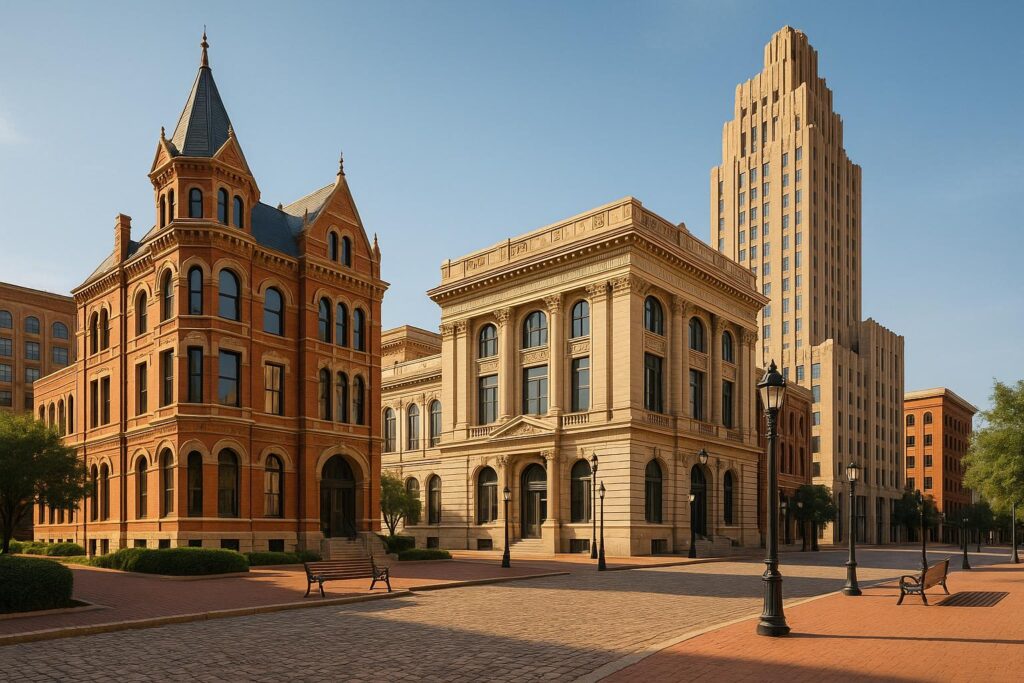
Downtown Fort Worth boasts a rich collection of late 19th- and early 20th-century architecture, showcasing styles like Victorian, Beaux-Arts, and Art Deco. Key landmarks include the Tarrant County Courthouse, Sundance Square, and the Texas & Pacific Terminal, each reflecting pivotal moments in the city’s growth from a cattle town to an urban hub.
This article outlines walking tours tailored to various interests, featuring buildings such as the Burk Burnett Building (1914), the Sinclair Building (1930), and the Knights of Pythias Castle Hall (1901). It also provides practical tips on timing, weather preparation, and parking to ensure a smooth visit.
Highlights:
- Walking Routes: Options range from a quick 2-hour tour to a full-day exploration.
- Styles to See: Romanesque Revival, Art Deco, and Beaux-Arts.
- Key Stops: Tarrant County Courthouse, Texas & Pacific Terminal, and Sundance Square.
- Visitor Tips: Best times to visit, what to bring, and parking advice.
Whether you’re interested in history, design, or photography, Fort Worth’s downtown offers a walkable glimpse into its architectural legacy.
Walking Through Downtown Fort Worth
Main Walking Route and Key Stops
Kick off your journey at the Tarrant County Courthouse on Main Street and wind your way south through Sundance Square, ending at the Texas & Pacific Terminal/Post Office complex. This walk spans about 1.5 to 2 miles and takes 60–90 minutes at a leisurely pace. If you plan to explore building interiors or spend extra time in plazas, set aside 2–3 hours for the full experience.
Start by admiring the courthouse’s grand dome and classical design. As you head south along Main Street, you’ll encounter architectural gems like the Flatiron Building near Houston & 9th. Sundance Square is home to landmarks such as the Burk Burnett Building at 500 Main, Fort Worth’s first true skyscraper built in 1914, and the Sinclair Building, a stunning 1930 Art Deco tower adorned with ziggurat motifs. Don’t miss the beautifully restored Victorian structures like the Land Title Block (1889) and the Knights of Pythias Castle Hall (1901), a medieval-inspired treasure that adds a touch of whimsy to the route.
Continue south past the convention center, where the route concludes at the T&P Terminal. Here, you can marvel at the Art Deco interiors and the adjacent Beaux-Arts post office, which still operates today.
This walking tour is just one of the options featured in this guide. Next, let’s look at the best times to visit and what essentials you’ll need to bring.
When to Visit and What to Bring
Plan your visit for the morning or late afternoon to avoid the intense summer heat. Weekdays and Saturdays usually offer more street activity and better access to building interiors, while early Sunday mornings are quieter but may limit opportunities to explore inside. Spring and fall are ideal for pleasant weather, though occasional thunderstorms can pop up.
Be prepared! Wear comfortable shoes, check the weather, and bring water along with sun protection. Essentials like a hat, sunglasses, and sunscreen will make the walk more enjoyable under the Texas sun. A map or smartphone will help you navigate the route with ease.
Once you’ve packed your essentials, it’s time to sort out how to get there and where to park.
Getting There and Parking
For those arriving by train, both TEXRail (from DFW Airport) and the Trinity Railway Express (TRE) (from Dallas) stop at the T&P Station, making it a convenient starting or ending point. From the station, it’s just a short walk north to connect with the route near the convention center and Sundance Square. Alternatively, you can begin the tour in reverse, starting at the T&P Terminal and heading toward the courthouse.
If you’re driving, there are plenty of parking options. Parking garages and surface lots near Sundance Square and the courthouse offer hourly and daily rates in US dollars. Some garages even provide free parking during evenings or weekends. If you’re staying outside the downtown area, such as at Aloft Trophy Club Westlake, downtown Fort Worth is just a 20–25 mile drive, making it an easy day trip to enjoy this historic walking route.
Downtown Fort Worth Walking Tour (Sundance Square to the Courthouse)


Key Historic Buildings to See
As you explore the walking route, these landmarks vividly reflect Fort Worth’s rich architectural history.
Tarrant County Courthouse
The Tarrant County Courthouse is one of Fort Worth’s most iconic civic landmarks, commanding attention at the north end of Main Street with its grand design. Completed in 1895 by architects Gunn & Curtis, this Beaux-Arts structure was inspired by the Texas State Capitol. It features the same striking pink Texas granite and red sandstone accents. Its central clock tower and classical columns create a commanding presence, symbolizing Fort Worth’s rise as a regional government hub in the late 19th century.
Take a stroll around the building to admire its balanced design and intricate details. The pink granite, sourced from the same quarries as the State Capitol, shifts in color depending on the time of day, making mornings and late afternoons perfect for photography. Recognized on the National Register of Historic Places, the courthouse sits near the Courthouse Mall, serving as a gateway between downtown and the Northside area.
From here, head toward Sundance Square to discover more of Fort Worth’s architectural gems.
Sundance Square and Early Commercial Buildings
Sundance Square is home to some of Fort Worth’s best-preserved commercial buildings, located along Main Street between 3rd and 5th streets. Among them is the Burk Burnett Building, completed in 1914 at 500 Main Street. As the city’s first true skyscraper, this 12-story structure was designed by Sanguinet & Staats and features a striking neoclassical style. Its design includes a white terra-cotta base with granite columns, a red-brick shaft accented with terra-cotta details, and an ornate white terra-cotta cornice at the top.
Nearby, the Knights of Pythias Castle Hall, built in 1901, stands out with its medieval revival style. Designed by Sanguinet & Staats, its crenellated rooflines and turrets make it a rare example of this architectural approach on an American Main Street. Recognized on the National Register of Historic Places and as a Recorded Texas Historic Landmark, this building is a favorite for photos.
Another standout is the Sinclair Building at 512 Main Street, a prime example of Art Deco design. Completed in 1930 by architect Wiley G. Clarkson, this 16-story tower features a stepped, ziggurat-like profile and geometric accents characteristic of the Zigzag Moderne style. Inside, the restored lobby showcases period details such as metalwork, lighting, and decorative finishes, reflecting Fort Worth’s embrace of cutting-edge design during the interwar years.
Continue south to explore the Texas & Pacific Terminal and its neighboring federal building for a glimpse into Fort Worth’s rail era.
Texas & Pacific Terminal and Post Office Complex
The Texas & Pacific Terminal, opened in 1931, marks the southern edge of downtown and stands as a stunning example of Art Deco architecture. Built during Fort Worth’s railroad boom, the terminal features bold vertical lines, dramatic setbacks, and intricate geometric ornamentation in stone and metal. Inside, you’ll find plaster ceilings, terrazzo floors, and stylized fixtures that recall the glamour of 1930s rail travel. Today, the building has been repurposed as the T&P Lofts and serves as a rail station for TEXRail and TRE.
Next door, the U.S. Post Office and Federal Building, constructed around 1933, offers a contrasting Beaux-Arts style. Its symmetrical façades, pilasters, and classical details reflect the federal government’s role in Fort Worth’s growth as a rail and commercial hub during the early 20th century. Together, these buildings showcase the evolution of American public architecture, blending classical elements with the sleek lines of Art Deco, while highlighting Fort Worth’s importance as a major transportation center.
sbb-itb-1e56dfa
Walking Tour Options

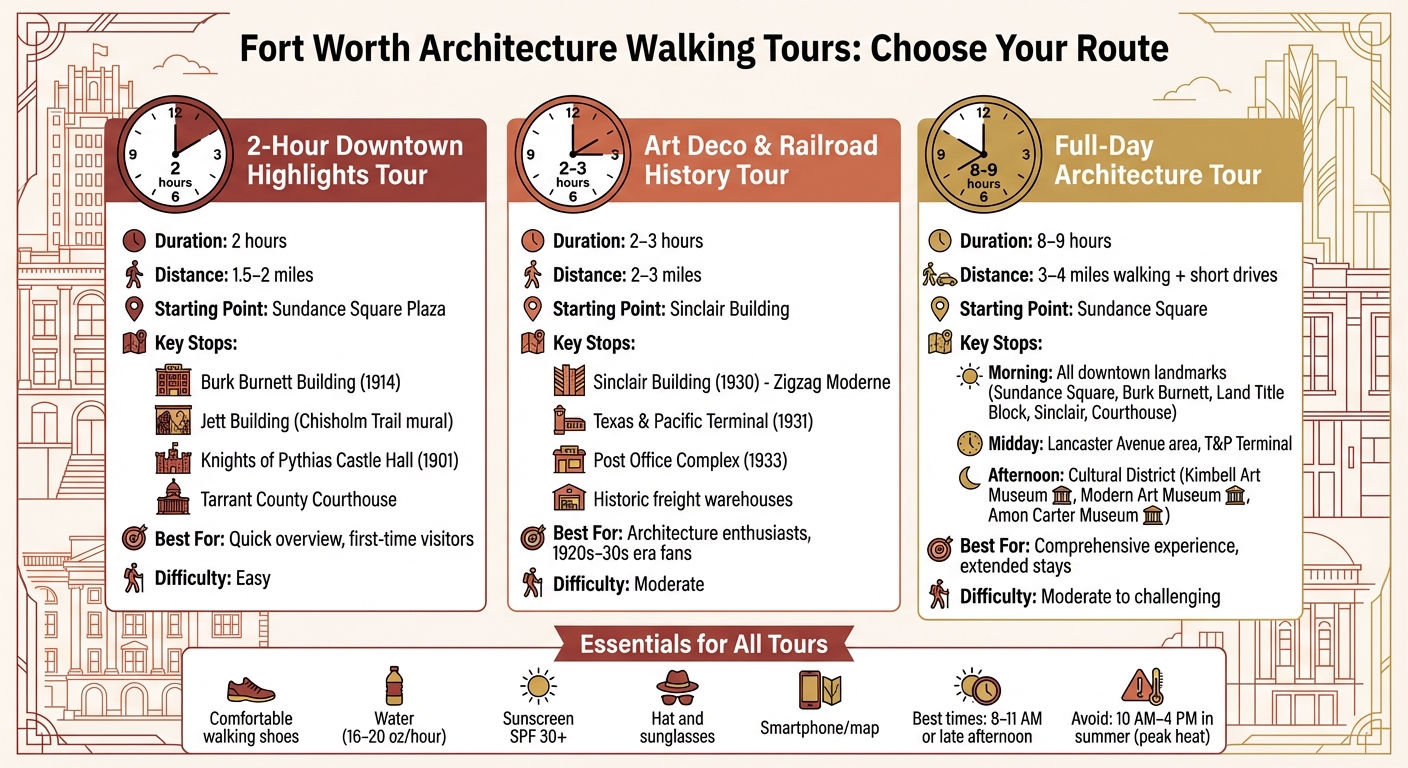
Fort Worth Downtown Architecture Walking Tours Comparison Guide
Explore Fort Worth through three carefully curated walking tours, each tailored to fit different schedules and interests.
2-Hour Downtown Highlights Tour
Start your journey at Sundance Square Plaza, a lively hub with convenient parking. From there, stroll north along Main Street to the Burk Burnett Building at 500 Main. This 1914 skyscraper stands out with its white terra cotta base and red brick upper floors. Next, visit the Jett Building near 400 Main, famous for its Chisholm Trail mural and its past as an interurban office. Continue to the Knights of Pythias Castle Hall at 315 Main, a 1901 gem showcasing medieval-revival architecture. Wrap up your tour by heading north to the Tarrant County Courthouse at the top of Main Street. On your way back, take Houston Street to admire more historic commercial towers before returning to Sundance Square. This route covers 1.5–2 miles and fits neatly into a two-hour timeframe.
Art Deco and Railroad History Tour
Dive into Fort Worth’s architectural boom of the 1920s and 1930s while exploring its railroad legacy. Begin at the Sinclair Building at 512 Main, a 1930 masterpiece by Wiley G. Clarkson, celebrated for its Zigzag Moderne design and intricate lobby details. From there, head to Lancaster Avenue to visit the Texas & Pacific Terminal and Post Office complex, where striking Art Deco design meets Beaux-Arts federal architecture. This tour also includes stops at historic freight warehouses, offering a glimpse into the role railroads played in shaping the city. In just two to three hours, you’ll gain a deeper appreciation for Fort Worth’s architectural and industrial history. If you’re looking for even more, consider the next option for a full-day adventure.
Full-Day Architecture Tour
This comprehensive tour begins with a morning walk through downtown’s iconic landmarks, including Sundance Square, the Burk Burnett Building, the Land Title Block (1889), the Sinclair Building, and the Tarrant County Courthouse. Midday, shift focus to the Lancaster Avenue area, featuring the T&P Terminal and nearby historic sites. In the afternoon, take a short drive to the Cultural District, home to architectural marvels like the Kimbell Art Museum by Louis Kahn, the Modern Art Museum of Fort Worth by Tadao Ando, and the Amon Carter Museum by Philip Johnson. This tour blends three to four miles of walking with brief drives, creating a rich 8–9-hour itinerary.
Guests staying at Aloft Trophy Club Westlake can easily plan a full-day outing. Start with a morning downtown tour, spend the afternoon exploring the Cultural District, and return to the hotel for dinner at the on-site restaurant or a relaxing evening at the W XYZ Lounge.
Each of these routes offers a distinct perspective on Fort Worth’s architectural and historical evolution, ensuring visitors leave with a deeper connection to the city’s vibrant heritage.
Tips for Visiting
To make the most of your journey along Fort Worth’s historic route, here are some practical tips to keep in mind.
Self-Guided Tour Resources
If you’re planning a self-guided tour, there are plenty of digital and printable resources to help you navigate. The Fort Worth Architecture website (fortwortharchitecture.com) is a treasure trove of information, featuring detailed lists of downtown’s notable buildings, complete with their construction dates, architects, and architectural styles. From the Tarrant County Courthouse to the Flatiron Building, this site is an excellent starting point for mapping out your route. For a printable option, Downtown Fort Worth, Inc. offers an architectural guide that traces the city’s journey from its humble 1849 log cabins to its modern skyline.
Prefer mobile tools? The Visit Fort Worth app includes walking tour features for Sundance Square and nearby landmarks. Meanwhile, the National Register of Historic Places app highlights NRHP sites like the Knights of Pythias Building (1901). For a more immersive experience, the Sundance Square app provides augmented reality overlays that bring historic commercial buildings to life. Be sure to download these apps and guides before your visit, as connectivity can be spotty in some areas. With these tools in hand, you’ll be ready to explore Fort Worth’s historic gems while respecting local access rules.
Building Access and Visitor Etiquette
Many of Fort Worth’s historic buildings are open to the public, offering a glimpse into the city’s rich past. For instance, the Tarrant County Courthouse (1895) allows visitors to admire its pink Texas granite Beaux-Arts interior during business hours, though photography is prohibited in active courtrooms. The Texas & Pacific Terminal has public lobbies and still operates as a commuter rail station, while St. Patrick Cathedral welcomes visitors during services. The Post Office in the T&P Complex is also operational and open to the public.
Remember to respect "No Trespassing" signs on private properties and stick to public sidewalks and plazas. Avoid climbing on structures or littering, and always yield to pedestrians on busy sidewalks. While exterior photography is encouraged, keep in mind that flash photography is not allowed inside public buildings. Supporting local businesses housed in restored historic buildings is another great way to contribute to preservation efforts. Above all, be courteous and prepared for Fort Worth’s unpredictable weather.
Preparing for Fort Worth’s Weather
Fort Worth’s climate can be unpredictable, so it’s important to come prepared. Summers are hot and humid, with July temperatures averaging 95°F (35°C) and heat indices often exceeding 105°F. Winters, on the other hand, are mild, with January lows around 35°F (2°C). The UV index remains high throughout the year, and spring and fall often bring sudden thunderstorms.
During the summer, dress in lightweight, breathable layers, and don’t forget a wide-brim hat and SPF 30+ sunscreen (reapply every two hours). Stay hydrated by drinking 16-20 ounces of water per hour. In winter, a light jacket and gloves should be enough to keep you comfortable. Plan your tours for early mornings (8–11 AM) or evenings to avoid the midday heat. If you’re out during the peak sun hours (10 AM–4 PM), take breaks in shaded areas like Sundance Square and carry electrolyte packets if you’re planning a longer tour.
Conclusion
Downtown Fort Worth offers a vivid snapshot of over a century of American architecture, all within a few walkable blocks. From Sundance Square, you can take in a remarkable view: pink-granite courthouses from the 1890s, brick-front mercantile buildings from the early 1900s, Art Deco railroad terminals from the 1920s, and sleek glass-and-steel towers of the 21st century. This seamless blend of old and new captures the essence of Fort Worth, showcasing its transformation from a frontier town to a modern metropolitan hub – all while staying true to its Cowtown heritage.
To truly experience this architectural journey, take advantage of the curated tour routes. Whether you opt for a quick 2-hour highlights tour, an Art Deco & railroad-focused route, or a full-day exploration, these itineraries provide a great starting point. Begin at iconic landmarks like the Tarrant County Courthouse on Main Street or the Texas & Pacific Terminal near the Water Gardens, and then tailor your adventure to your interests. There’s no wrong way to explore – just be sure to slow down, take in the details, and appreciate the unique character of each building.
History buffs will enjoy tracing Fort Worth’s evolution, from its 19th-century log cabins to its rise as a rail hub and financial center. Photographers will find endless inspiration in the textures and contrasts – think terra-cotta details, brick cornices, Art Deco reliefs, and shimmering glass façades that shift with the light throughout the day. Families can enjoy the wide sidewalks and open plazas that make for a relaxed and manageable walk, while business travelers will appreciate the convenience of fitting a short architecture loop into a busy schedule thanks to the proximity of key sites and transit options.
If you’re staying longer, consider modern accommodations like Aloft Trophy Club Westlake, which offers comfort and convenience for extended visits.
Before wrapping up your trip, grab a map – digital or printed – and set aside time to wander and soak in the beauty of these striking façades. Local organizations like Downtown Fort Worth, Inc. and Historic Fort Worth are dedicated to preserving this rich architectural heritage, ensuring that future generations can continue to enjoy the city’s unique blend of styles.
FAQs
What are the top historic buildings to see on a downtown Fort Worth architecture tour?
Downtown Fort Worth is a treasure trove of history and stunning architecture. Among its standout landmarks is the Flatiron Building, one of the city’s first skyscrapers, showcasing early 20th-century design. The Tarrant County Courthouse impresses with its late 19th-century Renaissance Revival style, standing as a testament to timeless craftsmanship. And, of course, the Fort Worth Stockyards vividly capture the city’s Western roots, offering a window into its rich cowboy heritage. These iconic sites are perfect for anyone looking to dive into Fort Worth’s colorful history.
What is the best time of year to explore the historic architecture in downtown Fort Worth?
The best time to visit Fort Worth’s historic downtown is in the spring (March to May) or fall (September to November). During these months, the weather is mild and pleasant – ideal for strolling through the city and taking in its historic architecture.
These seasons allow you to explore comfortably, avoiding the scorching heat of summer or the colder winter temperatures.
What are the best tips for exploring Fort Worth’s historic downtown architecture?
To get the most out of your trip to Fort Worth’s historic downtown, it’s a good idea to plan your route around key landmarks like the Flatiron Building, Tarrant County Courthouse, and Union Depot. A detailed map or a guided tour app can help you navigate while uncovering the area’s rich history.
Make sure to wear comfortable walking shoes – exploring downtown often means covering several blocks on foot. Visiting earlier in the day can help you avoid crowds and enjoy a more relaxed experience. Many buildings feature informational plaques or are part of guided tours, offering fascinating insights into their architecture and history. And don’t leave your camera behind – these historic structures are full of intricate details worth capturing!