

Gamification can transform your corporate events into engaging, interactive experiences. By incorporating elements like leaderboards, challenges, and rewards, you can boost attendee participation, improve networking, and create memorable moments. Here’s a quick summary of how to make it work:
- Set Goals: Define clear objectives (e.g., engagement, learning, sponsor visibility).
- Know Your Audience: Tailor activities to suit different preferences (e.g., introverts vs. extroverts).
- Pick Game Mechanics: Use tools like scavenger hunts, quizzes, or team-based challenges.
- Leverage Technology: Choose reliable event apps for tracking points, leaderboards, and real-time updates.
- Plan Rewards: Offer prizes like gift cards, digital badges, or exclusive experiences to motivate participation.
- Analyze Results: Track engagement metrics, gather feedback, and refine your strategy for future events.
Gamification is about turning passive attendees into active participants. With careful planning and the right tools, you can create events that are not only fun but also impactful.
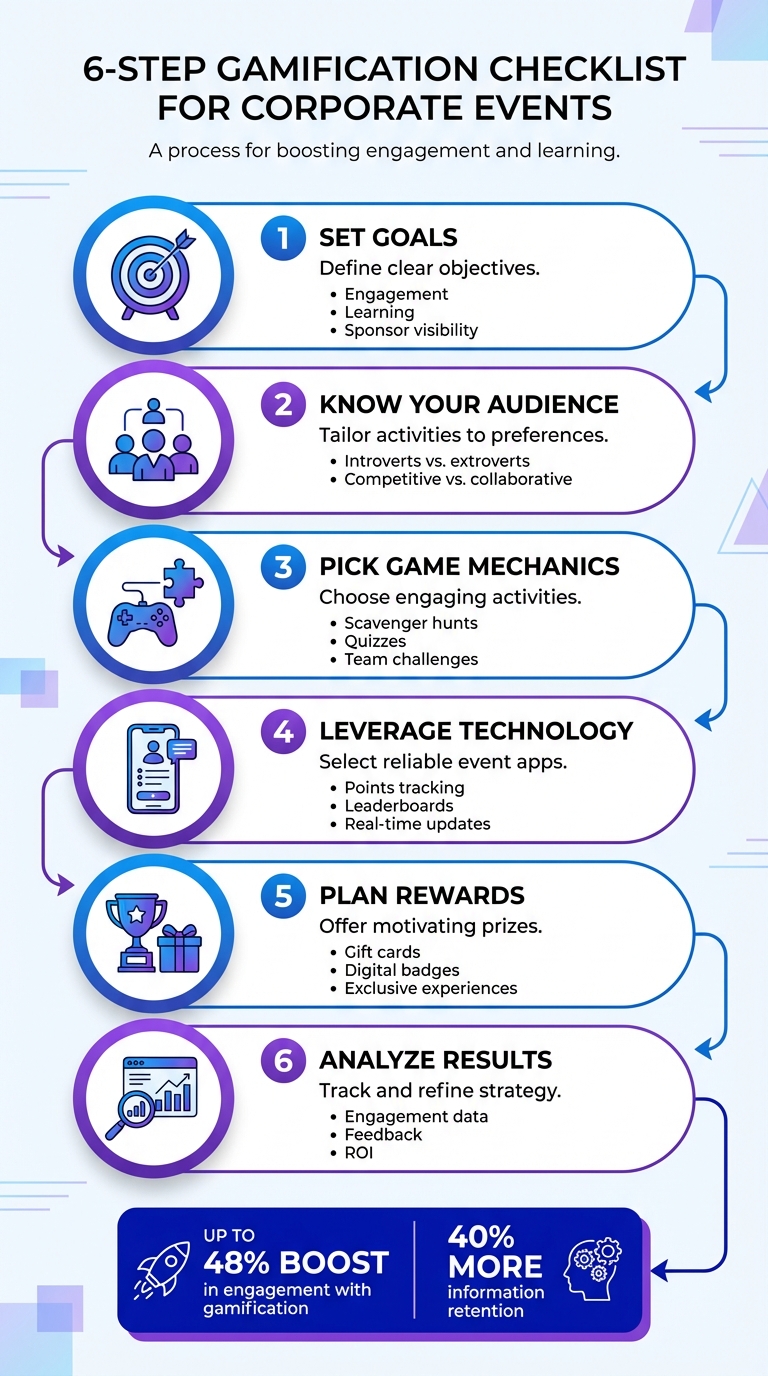
6-Step Gamification Checklist for Corporate Events
Gamify Your Event: Tested Strategies That Actually Work [Event Insider 35]
Pre-Event Planning: Prepare Your Gamification Strategy
To craft an effective gamification strategy, start by setting clear goals, understanding your audience, and choosing game mechanics that align with both.
Set Clear Event Goals and Gamification Targets
Define what you want to achieve with gamification. Are you aiming to boost attendee engagement, increase sponsor visibility, enhance learning retention, or improve session attendance? Each of these objectives calls for a tailored approach.
For instance, if networking is your priority, consider mechanics like "Networking Bingo" or rewarding contact exchanges. To reinforce learning, session quizzes or trivia games can help attendees retain information. When sponsors need more traffic, QR code scavenger hunts or badge scanning at booths can deliver leads and foot traffic. If improving attendance patterns is the goal, offer rewards for early check-ins or attending specific sessions.
The key is aligning your game mechanics with your objectives. The better the match, the more effective your gamification efforts will be.
Research Your Audience
Understanding your audience is critical to designing a gamification strategy that resonates. Different personality types engage with different activities. Extroverts may enjoy team-based challenges like escape rooms or group competitions, while introverts might prefer solo activities such as trivia or puzzles they can do on their own. Competitive attendees might be drawn to leaderboards and badges, while those who value collaboration may respond better to team-based activities.
Gather this information during registration to identify preferences and strike a balance between competitive and collaborative elements, ensuring an inclusive experience for everyone.
"By being aware of your attendees’ needs, you can shape your gamification in a way that will spark their interest and lead to maximum engagement." – Hubilo
Also, consider the format of your event. Virtual attendees might need gamification to shift from passive viewing to active participation, while in-person attendees may benefit from activities that ease the pressure of face-to-face interactions. Tailoring your strategy to these differences ensures a smoother experience and avoids overwhelming participants.
Once you understand your audience, select mechanics that cater to their preferences and enhance their overall experience.
Select Appropriate Game Mechanics
Choose mechanics that are simple and easy to grasp. If participants need a lengthy explanation or rulebook, they’re less likely to engage.
For example, scavenger hunts using QR codes can guide attendees through an expo, while live polls and quizzes during educational sessions help reinforce key takeaways. Photo contests and social media challenges can amplify your event’s reach, while leaderboards add a competitive element. To keep things fair, refresh leaderboards daily, giving new participants a chance to catch up.
Make sure your mechanics fit your venue. Modern spaces like Aloft Trophy Club Westlake offer flexible layouts that can accommodate both app-based digital games and physical activities. Before finalizing your gamification plan, confirm that your venue can support the activities you want to implement. This ensures your games run smoothly and align with the event’s practical setup.
Choose Tools and Technology for Gamification
Picking the right tools and technology is a game-changer for your gamification strategy. Once you’ve mapped out your plan, focus on selecting a reliable digital platform that can handle all the moving parts. Your platform should track points, update leaderboards in real time, and operate smoothly even under heavy usage. Event apps like Accelevents, Bizzabo, EventMobi, and Hubilo are designed for these tasks and can handle up to 10,000 attendees at once. Look for platforms that let you reward actions like visiting exhibitor booths, participating in Q&A sessions, or networking with other attendees.
Event Apps and Software Platforms
A good event app does more than just display a schedule. Key features to look for include real-time leaderboards that update automatically, digital badges to mark achievements, and push notifications to keep attendees engaged with reminders or reward announcements. Tools like QR code scanning can encourage participation by making it easy to unlock challenges or earn points. Analytics and reporting features are another must-have, as they give you a clear picture of how attendees are engaging and progressing.
Interactive Tools and Features
Interactive tools can take your gamification efforts to the next level. Platforms like Slido and Kahoot work great for live trivia challenges, while augmented reality scavenger hunts or virtual reality demos can add an exciting twist. QR codes placed strategically around the venue can unlock puzzles, provide clues, or award bonus points, turning passive attendees into active participants. For rewards, services like TruCentive allow you to send digital gift cards instantly via SMS or email, giving winners the freedom to pick their preferred retailer. Keep in mind that around 20–25% of digital incentives might go unclaimed, so plan your budget accordingly. Just make sure your venue’s infrastructure can handle these interactive features without a hitch.
Venue Requirements
A seamless gamification experience depends on your venue’s technical setup. High-density WiFi is a must, especially if hundreds or thousands of attendees will be using the platform simultaneously. Look for venues with flexible layouts that can accommodate both digital and physical game elements, as well as digital signage for displaying live leaderboards. For example, Aloft Trophy Club Westlake offers reliable WiFi, modern event spaces perfect for app-based games or physical activities, and adaptable room configurations for team challenges or individual competitions. Be sure to walk through the venue beforehand to check for any WiFi dead zones and ensure everything integrates smoothly with your tools and platforms.
sbb-itb-1e56dfa
Run Gamification Activities During the Event
Start Gamification Activities
Kick things off with gamification as soon as attendees arrive. Offer "Early Check-in" bonuses, like extra points, to reward punctuality and get people engaged right away. During the opening session, make a big announcement about the game. Use speakers and push notifications to explain the rules, highlight the prizes, and build excitement. Keep instructions short and straightforward so participants can dive in without confusion. Adding a "tutorial level" or a simple introductory activity can help attendees get familiar with the game mechanics in a low-pressure way.
Start with icebreaker games like "Networking Bingo" or "Jam Bingo" to help attendees connect and get conversations flowing naturally. Display real-time leaderboards on large digital screens in high-traffic areas like the registration desk to spark a competitive vibe from the start. Events that include gamification have shown up to a 48% boost in engagement compared to those that don’t, and they can drive a 70% increase in interactions with exhibitors and speakers.
Once the games are underway, focus on real-time monitoring and rewards to keep the energy high.
Monitor and Reward Participation in Real-Time
Appoint a gamification manager to keep the game running smoothly. This person can monitor leaderboards, track participation, and address any issues that come up. Use tools like your event app or wearable tech, such as smart badges, to automatically log key activities like attending sessions, networking, or visiting booths. Keep the competition alive by showing live rankings on screens and within the app, and highlight the top 21 participants to keep things exciting.
Venues with strong digital setups – like Aloft Trophy Club Westlake – make it easier to integrate interactive screens and maintain reliable connectivity for real-time updates.
Monitor live data to tweak activities if needed. If engagement feels too low or too overwhelming, adjust the difficulty or roll out hidden challenges at a steady pace. Celebrate milestones with instant rewards via SMS or email – SMS often feels more personal and grabs attention quickly. Publicly recognize top participants during keynotes or transition periods to keep the momentum going. For instance, the Canadian Society of Association Executives (CSAE) saw a 90% attendee engagement rate with gamification through an event app, and 91% of event organizers using apps report a positive return on investment.
Beyond individual tracking, team-based challenges can take engagement to the next level.
Encourage Team-Based Activities
Building on your pre-event plans, team challenges can deepen engagement and help achieve event goals. Incorporate activities like trivia matches, Corporate Olympics, or escape room puzzles to encourage teamwork and collaboration. Mix up the teams with people from different departments or backgrounds to create new connections and break down silos. Use a scoring system where individual contributions feed into a team’s overall score, which can be displayed on a live leaderboard.
You can also encourage audience participation by letting attendees vote for the "best question" or "best answer" during sessions. Studies show gamification can improve organizational efficiency by over 50%, and 81% of participants report feeling more socially connected at work when gamification is used. Offering a mix of team and solo challenges ensures everyone feels included.
Rewards and Post-Event Analysis
To wrap up a successful gamification strategy, you need two key elements: enticing rewards and a thorough post-event analysis. These steps tie everything together, building on the initial setup and the real-time engagement during the event.
Create Attractive Rewards
Rewards are the backbone of any gamification strategy. They should match the effort required to earn them. For example, small tasks like early check-ins could be rewarded with a cup of coffee or a digital badge, while more significant accomplishments, such as attending all sessions in a specific track, might merit gift cards or tech gadgets. Digital badges and trophies are great for instant recognition and can be displayed on social profiles, while physical rewards like branded T-shirts or mugs leave a lasting impression.
Gift cards, especially for platforms like Amazon, DoorDash, or Visa, are an excellent choice because they offer flexibility. Keep the selection limited to a handful of options (around six) to make the decision process easier for participants. Delivering rewards instantly through SMS or email after task completion adds an extra layer of excitement and satisfaction. For top performers, consider high-value rewards like one-on-one coaching with executives, VIP dinners, or exclusive access to future events.
"If you have interesting prizes, then the game practically will run itself!" – Accelevents
Social recognition also goes a long way. Real-time leaderboard placements, public shout-outs, and peer acknowledgment can be incredibly motivating [6, 12]. Additionally, sponsor-provided perks like discounts, free trials, or coupons not only reward attendees but also create lead generation opportunities for sponsors.
Analyze Engagement and Results
Once the event ends, it’s time to dive into the data. Evaluate key engagement metrics to understand what worked. Use your event app’s dashboard to track stats like session attendance, booth visits, poll participation, chat activity, and networking interactions (e.g., new connections or meeting requests) [12, 17]. Post-session quizzes can also reveal how well attendees absorbed the event’s key messages [12, 13].
Take, for instance, The Delegate Wranglers’ "Nearly Christmas Party" in November 2023. Led by Neil Thompson, this event used app-based challenges, quizzes, and social media activities from the moment registration opened. The result? A participation rate of 50–75%, generating pre-event excitement and meaningful networking opportunities during the event itself.
To measure sponsor ROI, look at metrics like lead quality, booth traffic, and resource downloads tied to gamified activities [13, 17]. Tools like UTM links and QR codes can help track specific interactions. Social media engagement – hashtags, selfies, or user-generated content tied to challenges – provides another layer of insight. Compare participation rates between individual and team-based challenges to identify audience preferences.
Collect Feedback for Future Events
After analyzing the data, gather direct feedback to fine-tune your gamification approach. Incentivize surveys with points, badges, or prize draw entries to boost participation. Keep surveys short – 8 to 10 targeted questions work best for higher completion rates. Use a mix of multiple-choice questions, rating scales, and open-ended questions to gather both quantitative and qualitative insights. Personalize surveys by addressing attendees by name and tailoring questions to their role, whether they were a speaker, sponsor, or general participant.
"Gamification is worth the investment of your time, 100%, no question about it. My attendees come up to me all the time and wonder why we didn’t implement gamification into our events sooner!" – Amy Moore, Events Manager, Public Relations Society of America
Ask attendees which game mechanics they found engaging and which felt more like a chore. This feedback complements raw data with valuable sentiment analysis. Use simple rating systems (e.g., 1–5 or 1–10 scales) to streamline data analysis. For hybrid events, compare feedback and metrics from both in-person and virtual attendees to uncover any gaps in their experiences. Finally, track which rewards were the most popular to refine your offerings for the next event.
Conclusion
Gamification transforms passive events into dynamic, unforgettable experiences. Research shows that participants can retain up to 40% more information when content is delivered through game mechanics. This checklist covers everything from initial planning to post-event analysis, giving you the tools to make your events truly stand out.
The venue you choose plays a critical role in achieving these outcomes. A well-equipped venue can make or break your gamification efforts. Modern spaces need to support event apps, live leaderboards, and interactive tools seamlessly. For example, Aloft Trophy Club Westlake (https://alofttrophyclub.com) offers high-speed WiFi throughout the property, flexible meeting areas with advanced AV capabilities, and social hubs like the W XYZ Lounge – perfect for networking and gamified activities. These features create the ideal environment for digital scavenger hunts, team trivia, and more.
"There’s no one without purpose in a game. That’s what Gamification is all about." – Vineet Raj Kapoor
The numbers speak for themselves: the global gamification market is currently valued at $11.94 billion and is expected to soar to $58.8 billion by 2028. Real-world success stories back this up – like the Canadian Society of Association Executives, which achieved a 90% attendee engagement rate with their gamification challenge.
Start small with one or two game mechanics, listen to participant feedback, and build from there. With thoughtful planning, actionable insights, and the right venue, you’ll be well on your way to hosting corporate events that leave a lasting impression.
FAQs
How do I make sure gamification supports my event goals?
To make sure your gamification strategy hits the mark, start by setting clear objectives. Think about what you want to accomplish – whether it’s increasing session attendance, encouraging networking, or giving sponsors more visibility. Once you’ve nailed down your goals, figure out the specific actions attendees can take to help you achieve them. For example, you might reward people for visiting exhibitor booths or sharing event photos. Then, design game mechanics – like points or prizes – that incentivize those behaviors.
It’s also important to consider your audience. Look at the different groups involved, such as attendees, sponsors, and speakers, and pinpoint the behaviors you want to encourage for each. Use tools like points systems, badges, or challenges to track their progress. Set measurable targets, like having a certain percentage of participants complete specific activities, to gauge success.
Before the big day, test your gamification plan with a small group to make sure everything works smoothly. Use their feedback to tweak things like reward structures or the difficulty of challenges, keeping the experience engaging for everyone. A unified theme can also make a big difference. For instance, a corporate event at Aloft Trophy Club Westlake could feature an "innovation quest" theme to tie everything together and leave a lasting impression. By aligning your game mechanics with your event goals, you’ll create an experience that’s both fun and effective.
What are some gamification ideas to engage different types of event attendees?
To make your event at Aloft Trophy Club Westlake more interactive, consider tailoring activities to fit the preferences of your attendees. Here are some ideas to get started:
- For competitive spirits: Incorporate real-time leaderboards, award points for completing tasks, and offer tiered rewards for top achievers.
- For team players: Organize group activities like scavenger hunts, team trivia games, or collaborative problem-solving challenges.
- For networkers: Include ice-breaker games like networking bingo, where meeting new people earns rewards, or quests that encourage exchanging business cards.
- For laid-back guests: Engage them with simple, fun activities such as photo challenges, collecting digital badges, or earning small prizes for check-ins.
Mixing these approaches can create an event that feels dynamic and engaging, ensuring there’s something enjoyable for everyone.
What technology tools are necessary for adding gamification to events?
To bring gamification into your event effectively, having the right technology tools is a must. Start with a mobile-friendly event app. This will be your go-to for incorporating features like points, badges, leaderboards, and real-time challenges. These apps make it simple for attendees to participate and track their progress throughout the event.
Behind the scenes, you’ll need a back-end platform to create, manage, and oversee the gamification elements. Look for platforms offering features like quizzes, scavenger hunts, virtual prize wheels, and real-time analytics that can instantly update leaderboards. Many of these tools also integrate seamlessly with CRM or marketing systems, making it easier to use engagement data for follow-ups and reporting.
By combining a user-friendly app, flexible gamification tools, and robust analytics, you can turn your event into an interactive and memorable experience for your attendees.