
Group hotel reservations, or room blocks, are essential for organizing events like weddings, corporate meetings, and sports tournaments. Booking 10 or more rooms guarantees discounted rates and simplifies logistics, but it requires careful planning and negotiation. Here’s what you need to know:
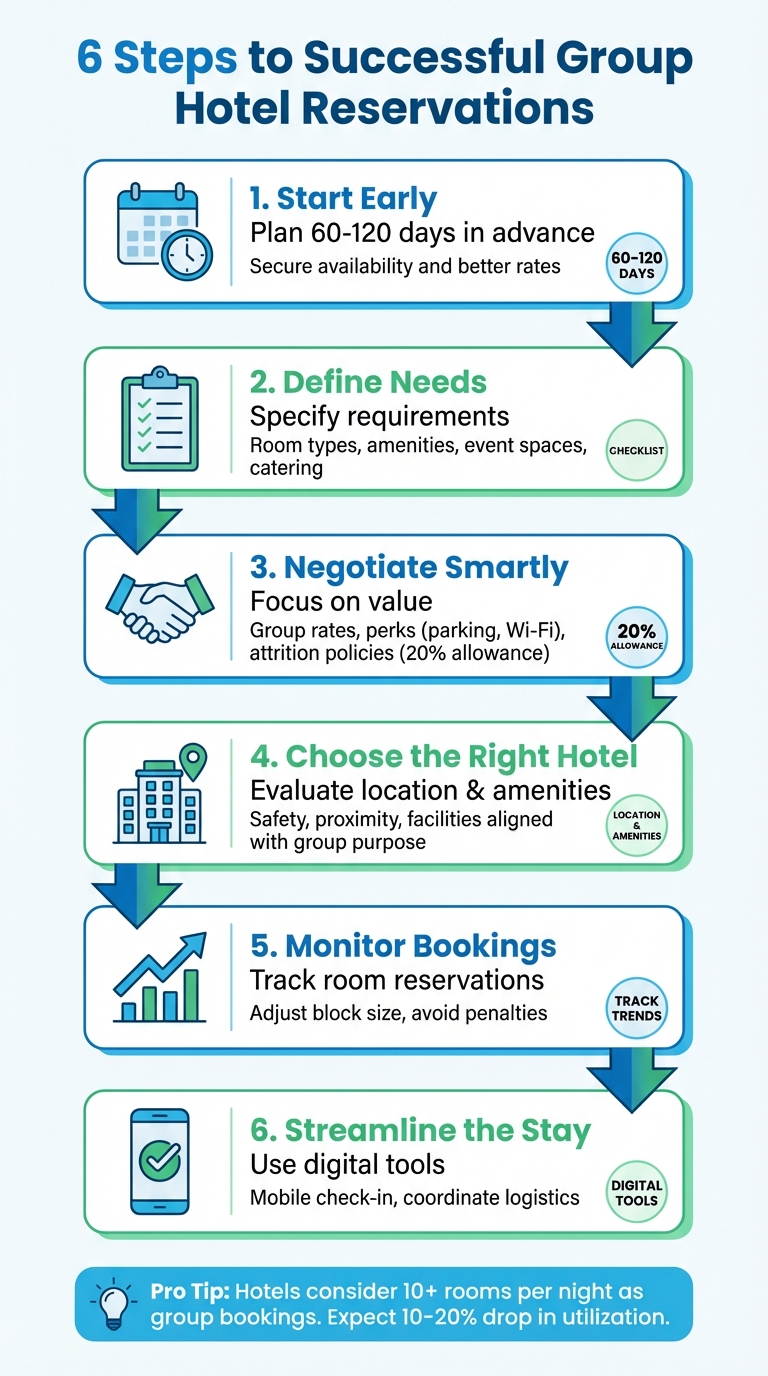
- Start Early: Plan 60–120 days in advance to secure availability and better rates.
- Define Needs: Specify room types, amenities, and event requirements (e.g., meeting spaces, catering).
- Negotiate Smartly: Focus on group rates, perks (e.g., free parking, Wi-Fi), and contract flexibility like attrition and cancellation policies.
- Choose the Right Hotel: Consider location, safety, and amenities aligned with your group’s purpose.
- Monitor Bookings: Track room reservations to adjust your block size and avoid penalties.
- Streamline the Stay: Use tools like mobile check-in and coordinate logistics with the hotel to ensure a smooth experience.
For example, Aloft Trophy Club Westlake in Texas offers modern accommodations, meeting spaces, and group-friendly amenities, making it a solid choice for various events. Proper planning, clear communication, and post-event evaluations are key to successful group bookings.
6-Step Process for Successful Group Hotel Reservations
Planning and Defining Group Needs
Identifying the Group’s Requirements
Start by determining the exact number of rooms your group will need and specifying the types of rooms required (e.g., 25 king rooms, 10 queen rooms, 5 suites). Typically, hotels consider a group booking as a signed contract for 10 or more rooms per night.
Clearly outline the arrival and departure dates for each segment of your group. If some attendees plan to arrive earlier or leave later, note these variations. Offering flexible dates can sometimes lead to better rates, especially during periods when the hotel has lower occupancy. Additionally, rooms with one king bed tend to cost less than those with two double or queen beds. If your group primarily consists of solo travelers, opting for king rooms could help cut costs.
The purpose of the trip will influence your group’s requirements. Corporate groups, for instance, often prioritize high-speed internet, business centers, and meeting rooms. Youth sports teams may look for accommodations near competition venues, pools, and fitness facilities. Work crews might value proximity to job sites, breakfast options, and practical amenities, while educational groups often focus on affordability, safety, and quiet spaces for study. Identifying these priorities early on will help you communicate your needs effectively to potential hotels.
Don’t forget to include additional needs like conference spaces, A/V equipment, catering, and parking for buses or large vehicles. Establish a clear budget that accounts for not just the room rates but also any extra fees, such as parking, internet access, resort charges, or breakfast costs. Keep in mind that event planners typically anticipate a 10% to 20% drop in room utilization due to unforeseen issues like illness or travel disruptions. Factoring in this cushion can help you avoid last-minute complications.
Hotel Selection Criteria
Once you’ve defined your group’s needs, the next step is finding a hotel that meets them. Location is key – choose accommodations close to your primary event venue to minimize transportation costs and simplify logistics. For student or youth groups, the safety of the surrounding area is especially important. Corporate groups often prefer hotels near business districts, while wedding parties usually look for celebratory, family-friendly environments that are convenient for guests.
Evaluate the hotel’s on-site amenities to ensure they align with your group’s needs. Does the property offer the meeting space configurations you require? Is the Wi-Fi reliable? Are there fitness centers, pools, or other facilities your group will use? For example, Aloft Trophy Club Westlake offers modern meeting spaces, the W XYZ Lounge, and an outdoor pool, making it a great fit for many group types.
"The price of a hotel room hinges on whether your event is at a peak or off-peak time for the hotel." – Joyce Scardina Becker, Special-events Manager
Timing plays a big role in securing group reservations. Start planning 60 to 120 days in advance for standard dates, and even earlier during peak seasons. Before reaching out to the hotel’s group sales manager, research their public rates online to establish a baseline. This ensures that the group rate you’re quoted actually provides savings. Whenever possible, speak directly with the local property’s group sales manager instead of a national reservations line. This approach often leads to more personalized service and better negotiation opportunities.
Another consideration is the hotel’s ability to accommodate your overall spending. According to Tim Hentschel, CEO of HotelPlanner.com:
"The more you can do at the hotel, the more you’ll save. Total spend is a big part of booking hotels".
Planning group meals, happy hours, or other on-site activities can increase your leverage when negotiating lower room rates.
Creating a Requirements Brief
Once you’ve clarified your needs and chosen selection criteria, organize everything into a detailed requirements brief. A Request for Proposal (RFP) is a great tool for standardizing and communicating your expectations. This document should include specifics like room counts, dates, amenity preferences, and budget guidelines. Be sure to describe the purpose of your trip and your expected attendance so hotels can tailor their proposals to your group’s needs.
Structure your brief into key categories:
- Room Block Details: Total room nights, bed type preferences, and arrival/departure patterns.
- Event Space Requirements: Square footage, A/V needs, catering details, and preferred room layouts.
- Logistics: Transportation needs, parking for large vehicles, and check-in procedures.
- Financial Parameters: Budget limits, billing methods, and deposit schedules.
- Contract Terms: Policies on cut-off dates, attrition percentages, and changes.
Request separate proposals for room-only bookings and bundled services (e.g., parking, breakfast, meeting space) to compare overall value. Set a clear deadline for responses to keep your planning on schedule.
To avoid miscommunication, maintain a detailed spreadsheet with guest names, room types, ADA requirements, arrival times, and other key details. For groups needing ADA-accessible rooms, specify necessary features like grab bars or wheelchair ramps. If catering is involved, make note of any dietary restrictions.
Lastly, establish a timeline for your planning process. Start 90 days before the event, with key milestones at 60 days and 14 days prior to arrival. This structured approach will help streamline negotiations and ensure a smooth, well-coordinated group stay.
Securing and Managing Group Reservations
Steps to Secure Group Reservations
Once you’ve submitted your RFP and received proposals, reach out to the local sales department. This step often leads to more personalized service and better rates. When reviewing proposals, look beyond just the rates. Consider the overall value, such as complimentary perks like rooms, parking, Wi-Fi, or breakfast.
When it’s time to negotiate the contract, make sure it clearly outlines the room block size, rates, dates, and key policies. Most hotels define a group booking as 10 or more rooms per night, though some smaller or boutique properties may consider 5 rooms a group booking. Pay close attention to deposit terms, cancellation penalties (which often increase closer to arrival), and an attrition allowance – typically around 20% – to protect yourself if fewer rooms are booked than expected. Another key detail is a resale clause, which ensures you’re not charged for unbooked rooms that the hotel manages to resell. Also, include a walking provision to guarantee equivalent accommodations and transportation if the hotel overbooks and cannot honor your reservation.
Once the contract is squared away, your next step is deciding on the type of room block that aligns best with your group’s needs.
Understanding Room Blocks
Room blocks generally fall into two categories, each with different levels of commitment.
- Courtesy Block: This option holds rooms for your group without requiring financial liability. If guests don’t book the rooms by the cut-off date – usually about 30 days before arrival – they’re simply released back to the hotel’s inventory. This is a good choice for smaller gatherings or when attendance numbers are uncertain. However, it often comes with limited discounts and room availability.
- Contracted (or Guaranteed) Block: This type requires you to sign an agreement committing to fill a minimum percentage of rooms, typically around 80%. In return, you’ll get better rates and guaranteed availability for larger groups. But if your group falls short of the contracted minimum, you may face attrition penalties.
The cut-off date, when unreserved rooms are returned to the hotel’s general inventory, is usually set 30 to 60 days before arrival. After this date, any unbooked rooms are no longer available at your group’s negotiated rate. If your group’s bookings are lagging behind expectations, you might want to release some rooms back to the hotel before the cut-off date to avoid penalties.
Once you’ve chosen a room block type, maintaining a strong connection with the hotel is essential for smooth planning.
Coordinating with the Hotel
With the contract finalized, appoint a single point of contact to handle all communication with the hotel. This person will manage updates, name changes, and any special requests. To ensure everything runs smoothly, provide the hotel with a detailed rooming list in CSV format. Include guest names, arrival and departure dates, room types, ADA requirements, and any notes about late arrivals.
Regularly monitor your room pickup rate. Keep track of how many rooms have been reserved compared to your total block size, and share these updates with your hotel contact. If demand is higher than expected, you might be able to secure additional rooms at your negotiated rate. On the flip side, if bookings are slower than anticipated, you can discuss adjusting your block size to avoid attrition penalties. Most contracts allow guest name changes up to 48 or 72 hours before arrival, so confirm this detail with your hotel.
As the arrival date approaches, share logistics with the hotel. Provide details like the coordinator’s mobile number, group arrival times, shuttle or bus schedules, and any VIP early check-in needs. For example, if your group is staying at a property like Aloft Trophy Club Westlake – which features modern meeting spaces, the W XYZ Lounge, and an outdoor pool – coordinating access to these amenities ahead of time ensures your group can maximize their stay. Clear and proactive communication throughout the process is the key to a seamless experience for everyone involved.
Negotiating Group Rates and Terms
What You Can Negotiate
Start by locking in a favorable base room rate, but don’t stop there – dig deeper to uncover savings by cutting out hidden fees like resort, parking, and Wi-Fi charges. You can also leverage your total spending on food, beverages, and meeting spaces to negotiate better deals. For budgeting simplicity, ask for a blended rate – a single average price for all standard room types. This often comes with additional perks, such as discounts of 15–20% on audio-visual services, 10–15% on food and beverages, and improved complimentary room ratios (e.g., 1 free room for every 30–35 booked). Another cost-saving tip: assign solo travelers to one-king-bed rooms to lower overall expenses.
Contract Clauses to Review
Once you’ve identified potential savings, shift your focus to the contract details to ensure you lock in those benefits. Start with attrition allowances – aim for at least 20% flexibility so you won’t face penalties if attendance drops. Also, include a resale clause that limits your liability for unbooked rooms. This ensures you’re only charged for rooms the hotel is unable to resell.
Cancellation policies and payment schedules are other key areas to review. These should clearly define deadlines for canceling without penalties and outline charges for late cancellations. Pay attention to the cut-off date, which is typically 30 to 60 days before arrival. Negotiating a later cut-off gives attendees more time to book. Don’t overlook the force majeure clause – make sure it protects you if travel becomes impossible or illegal, not just if the hotel itself closes. It’s worth noting that about 91% of people accept terms and conditions without reading them, which can lead to missing critical protections in hotel contracts.
Negotiation Strategies
Once you’ve outlined the terms you want, fine-tune your negotiation approach to maximize value. Timing matters – closing contracts at the end of a quarter can work in your favor when sales teams are under pressure to meet targets. Be upfront about your budget and use 3–5 comparable proposals to create competitive leverage.
"The best deals lie at the end of a negotiation. Consider not just the room rate but also meals, Wi-Fi and other amenities." – Audrey Fairbrother, Content and SEO Manager, Engine
If attendees are covering their own room costs, consider negotiating a slightly higher rate that includes a rebate – typically $10 to $15 per night – credited back to the master bill. This can help offset expenses for food, beverages, or meeting spaces. Booking early, ideally a year in advance, can also help you lock in better rates before demand pushes prices higher. With the meeting and event industry accounting for about 20% of all U.S. hotel room revenue, hotels are eager to compete for your business.
sbb-itb-1e56dfa
Executing the Stay and Post-Event Follow-Up
Managing a Smooth Group Stay
Make check-in a breeze by encouraging everyone in your group to download the Aloft mobile app before arrival. At Aloft Trophy Club Westlake, features like Digital Check-In and Mobile Key allow guests to skip the front desk entirely, offering a fully contactless experience. Standard check-in opens at 3:00 PM, and check-out is at 12:00 PM.
"Our experienced meeting coordinator will ensure everything runs smoothly, so you can focus on your event." – Aloft Trophy Club Westlake
Marriott Bonvoy Elite Members may also enjoy priority access to late check-out perks. With an impressive 8.8/10 guest satisfaction rating, visitors often highlight the "easy check-in and check-out" process. These digital tools align perfectly with the efficient group management approach you’ve been building throughout your planning.
Using Hotel Amenities
Take full advantage of the blend of professional and social spaces at Aloft Trophy Club Westlake. Whether your group needs the Tactic Meeting Room for focused sessions or wants to combine the Event Space with the W XYZ Lounge and Backyard for a seamless transition to casual networking, the setup is designed to meet your needs. It’s an ideal arrangement for groups shifting from formal meetings to relaxed conversations over handcrafted cocktails.
For those juggling work and leisure – sometimes called "workations" – the hotel offers free wireless internet, a fitness center, and an outdoor pool to balance productivity with relaxation. Guest rooms are thoughtfully equipped with mini-fridges, coffee/tea makers, and 55-inch LCD TVs, ensuring convenience between activities. The 24/7 convenience store and complimentary coffee/tea service help keep energy levels up during multi-day events. Plus, free on-site parking and EV charging stations make logistics easier for everyone.
After making the most of these amenities, take some time to evaluate your stay to refine your future group booking strategies.
Post-Event Evaluation
Start by comparing the actual occupancy numbers to your contracted room block. Most contracts allow for roughly 20% attrition, as mentioned earlier. Instead of analyzing night-by-night variations, calculate attrition across the entire stay to account for natural fluctuations in arrival and departure patterns.
Next, review any unoccupied rooms under your resale clause. If the hotel managed to fill those rooms with other guests, you shouldn’t be held responsible for them. Confirm whether the "first resold rate" or "last resold rate" was applied, as outlined in your contract. When reviewing the final bill, go line by line to check charges for meeting spaces, audio-visual equipment, food and beverages, and any other services your group used. If any clauses seem unclear or disputes arise, ask the hotel salesperson to provide a plain-language explanation in writing.
How to Negotiate Group Hotel Rates Like a Professional Event Planner
Conclusion
Securing group hotel reservations requires early preparation, thoughtful negotiation, and consistent communication. Start by defining your group’s destination, dates, budget, and must-have amenities well in advance – ideally 60 to 120 days ahead, or even up to a year for peak travel seasons. Planning early not only ensures availability but also helps lock in competitive rates. This groundwork lays the foundation for smoother negotiations and a seamless booking process.
"The best deals lie at the end of a negotiation." – Audrey Fairbrother, Content and SEO Manager, Engine
Use the size of your group as leverage to negotiate perks like complimentary rooms, free breakfast, waived parking fees, or room upgrades. Pay close attention to contract clauses to avoid unexpected fees or penalties. Keep in mind that the meetings and events industry accounts for about $1 out of every $5 of U.S. hotel room revenue, giving you significant bargaining power during negotiations.
Selecting the right venue is crucial. For example, Aloft Trophy Club Westlake offers modern guest rooms, flexible meeting spaces, and a variety of amenities tailored to meet group needs. These strategies, paired with a detailed post-event review, complete a well-rounded approach to successful group reservations.
After your stay, take time to review the event’s outcomes. Compare the actual occupancy to your contracted block, confirm that resale clauses were applied correctly, and carefully examine the final bill for accuracy. This evaluation not only helps you avoid unnecessary charges but also improves your planning for future bookings.
FAQs
What should I consider when booking a hotel for a group stay?
When organizing a group reservation, start with the basics: location and accessibility. Opt for a hotel that’s close to business districts, airports, or popular attractions. Make sure it offers easy access to parking or public transportation, making it convenient for everyone in your group. Additionally, confirm that the property can handle your group size, whether that means reserving room blocks, event spaces, or even smaller breakout areas.
Next, focus on amenities that will enhance the experience for your group. Reliable high-speed Wi-Fi, on-site dining options, comfortable seating, fitness centers, and even a pool can go a long way in keeping guests both comfortable and productive. If your event requires it, check that the hotel provides the necessary technology and flexibility – things like A/V equipment, tech support, and customizable room layouts (whether you need theater seating, classroom-style setups, or a traditional conference arrangement).
Lastly, don’t overlook your budget and contract details. Ask for a clear cost breakdown to avoid surprises, and double-check policies around catering, setup, and cleanup. Booking early and providing specific details about your needs can often lead to better rates and added perks. For instance, Aloft Trophy Club Westlake is a great example of a property that offers modern meeting spaces, flexible group options, and a dedicated coordinator to ensure everything runs smoothly, whether you’re planning a corporate event or a leisure gathering.
What’s the best way to negotiate rates and terms for a group hotel booking?
To get the best rates and terms for a group hotel booking, it’s essential to first understand your group’s specific travel needs and preferences. Share important details upfront, like the number of rooms required, the expected dates of stay, and any additional requests such as meeting spaces or catering. Providing this information early can demonstrate the value your group brings, which often encourages hotels to be more accommodating.
When negotiating, focus on areas that can lead to meaningful savings. This might include securing discounted room rates, asking for waived fees (like parking or Wi-Fi), and requesting perks such as complimentary upgrades or added amenities. You can also negotiate flexible terms for attrition and cut-off dates to minimize potential penalties. Bundling services – such as event spaces or food and beverage packages – can further help streamline costs and simplify the process.
Starting the booking process early, ideally three to four months in advance, can give you more leverage and flexibility to negotiate terms. For instance, at Aloft Trophy Club Westlake, you can collaborate with a dedicated meeting coordinator who can help tailor group rates, waive specific fees, and provide access to modern event spaces. This ensures a smooth and well-organized experience for your group.
How can I effectively manage and track group hotel room bookings?
To efficiently handle group hotel room bookings, start by outlining your requirements. Determine how many rooms you’ll need, the types of rooms, and the specific dates for your stay. Once that’s clear, secure a written agreement with the hotel. This agreement should cover the group rate, deposit terms, and cancellation policies. To simplify the process, use a dedicated booking link provided by the hotel, which helps minimize errors and confusion.
Keep an eye on the booking progress by regularly comparing the number of reserved rooms to your initial forecast. If adjustments are needed, you can either release unused rooms or request additional ones before the hotel’s cut-off date. Be sure to track individual reservations and any special requests, ensuring they align with the hotel’s policies. Throughout the process, keep your group informed by sharing updates about deadlines or changes, which can help prevent last-minute issues.
By staying organized and proactive, you can make the booking process smooth and stress-free for everyone involved.